
Newsroom


Gray mold (Botrytis cinerea) is a devastating post-harvest disease of tomato (Solanum lycopersicum) that causes billions of dollars in global economic losses annually. As tomatoes ripen, they naturally become more susceptible to this destructive pathogen, the expression of which is regulated by ethylene response factors (ERFs). Current methods often have limitations regarding safety and sustainability. Exploring the molecular mechanism behind tomato fruit resistance is essential for developing new technologies that reduce post-harvest losses and maintain fruit quality.
In a study published in Postharvest Biology and Technology, researchers from the Wuhan Botanical Garden of the Chinese Academy of Sciences reported that the transcription factor SlERF.F4 plays a pivotal role in modulating tomato defense against B. cinerea. They found that SlERF.F4 transcripts are present in mature green fruits and are significantly increased upon infection.
Crucially, comparative analysis revealed that knocking out or knocking down SlERF.F4 increased fruit susceptibility to B. cinerea. Conversely, overexpressing SlERF.F4 slightly enhanced resistance, indicating that SlERF.F4 negatively regulates tomato fruits' susceptibility to B. cinerea.
Mechanistically, SlERF.F4 acts as a molecular bridge between fruit immunity and antioxidant defense. The jasmonic acid signaling component MYC2 activates SlERF.F4, which then induces key pathogenesis-related (PR) genes like PR2a, CHI1, and PR-STH2 to combat the pathogen directly. Simultaneously, SlERF.F4 regulates enzymes, including PR-9 (POD) and superoxide dismutase (SOD), to maintain reactive oxygen species (ROS) homeostasis and prevent oxidative damage.
Most importantly, SlERF.F4 enhances disease resistance without compromising fruit ripening or postharvest quality, making it as a highly promising target for breeding disease-resistant tomato varieties.
This study was supported by the National Natural Science Foundation of China, the Youth Talent Development Program of Hubei Province, and the Wuhan Talent Program, etc.
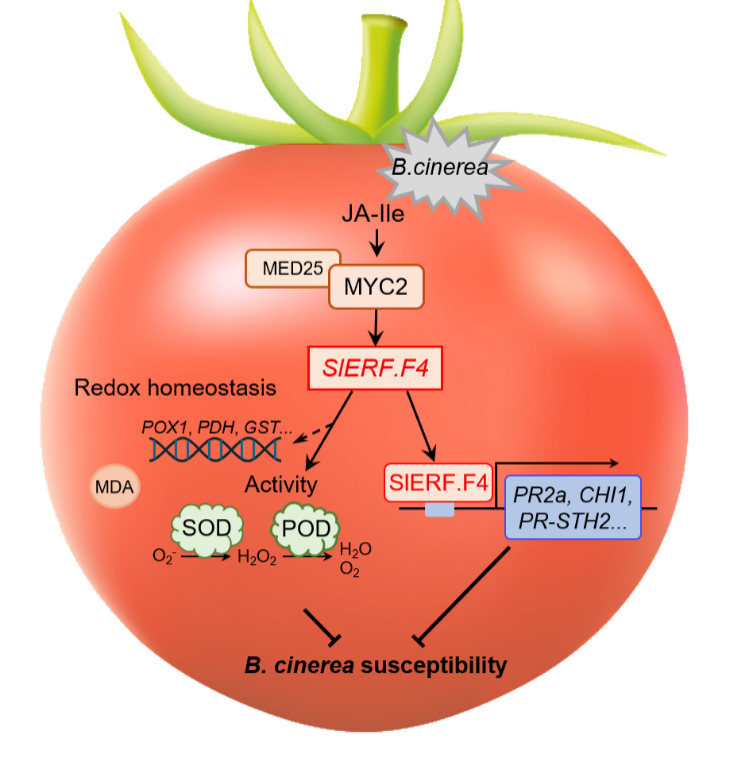
Schematic model of SlERF.F4-mediated defense against B. cinerea in tomato fruits (Image by WBG)
