Newsroom


Bacterial blight (BB) is a serious plant disease that mainly affects rice plants, especially in warm, humid regions. Due to the severity of BB, discovering and applying BB-resistance genes is strategically important for ensuring stable rice production in Asia. However, genetic strategies to improve disease resistance face a trade-off between crop yield and immunity to disease—since better immunity may be associated with lower yield.
To date, most BB resistance genes (Xa) that have been "cloned"—i.e., identified, isolated, and functionally validated—either originate from wild rice relatives or are loss-of-function mutations in susceptibility genes, suggesting that BB resistance may have been negatively selected during rice domestication.
Despite this finding, researchers recognized the importance of elucidating how resistance genes and their regulatory networks were differentially selected during domestication, in order to guide disease resistance breeding in rice.
To achieve this goal, Prof. HE Zuhua's team from the Center for Excellence in Molecular Plant Sciences of the Chinese Academy of Sciences, along with Prof. CHEN Gongyou's team from Shanghai Jiao Tong University and Prof. DENG Yiwen's team from Zhejiang University, cloned the broad-spectrum BB resistance gene Xa48. They elucidated a new model for broad-spectrum, durable BB resistance involving an NLR immune receptor and its cognate effector, and revealed the molecular mechanism by which XA48 coordinates growth and immunity during crop domestication.
The study was published in Nature on April 8.
Through large-scale germplasm mining, the researchers identified a novel BB resistance gene, Xa48, in the indica rice variety Shuangkezao (SKZ). Combining map-based cloning with GWAS analysis, they cloned the gene and showed that it encoded an NLR receptor protein. Screening and functional characterization identified its pathogenic cognate effector, XopG, and demonstrated that XA48 directly recognized XopG, thus triggering immune responses.
Systematic genetic, biochemical, and cell biology studies revealed that upon XopG recognition, XA48 promoted degradation of the downstream immune suppressor OsVOZ1/2, ultimately activating immune responses. This discovery provides a foundation for breeding high-yielding, disease-resistant rice varieties.
Moreover, the researchers investigated the domestication trajectory of XA48 to understand how it balances growth and immunity. They discovered that the gene encoding the downstream transcription factor OsVOZ1 has evolved two allelic variants: OsVOZ1A and OsVOZ1S. Japonica rice carries only OsVOZ1A, while indica rice has retained both.
The combination of Xa48 and OsVOZ1A imposed a reproductive penalty in japonica—an effect not seen in indica, ultimately leading to the functional loss of Xa48 in japonica. Accordingly, Xa48 was present only in indica (regardless of the OsVOZ1 variant), which is primarily grown in Southeast Asia, a region with high BB incidence. This geographic distribution was consistent with negative selection acting on the resistance gene in japonica, which is traditionally grown in Northeast Asia with lower BB incidence.
Furthermore, the researchers established an immune research platform centered on two major plant immune pathways—pattern-triggered immunity (PTI), mediated by RaxX-XA21, and effector-triggered immunity (ETI), mediated by AvrXa48-XA48—to systematically investigate their synergistic effects during pathogen infection. They developed a comprehensive PTI+ETI platform that integrates these immune networks to improve BB resistance. They also reconstituted broad-spectrum resistance from wild rice in modern rice, offering a novel strategy for sustainable control of crop diseases.
This study lays the foundation for advancing plant protection and crop breeding in China by providing genetic resources and technical support for improving crop disease resistance as part of rice breeding programs.
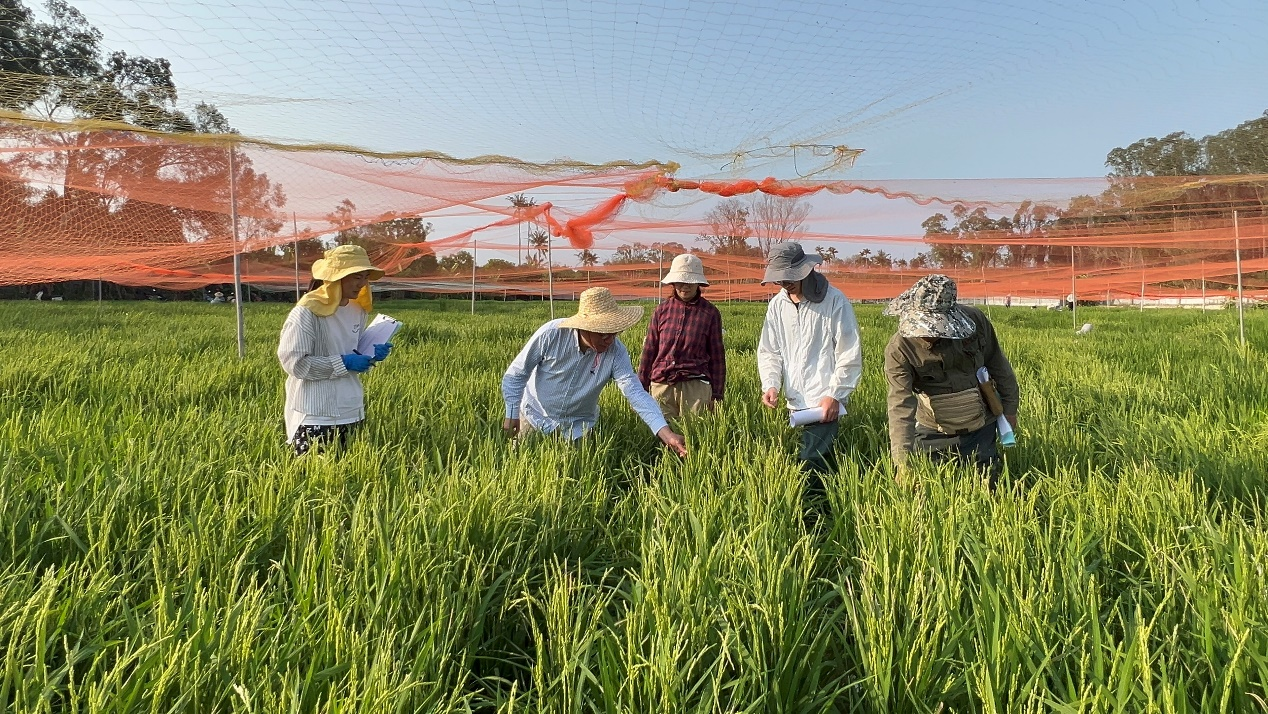
Researchers observe rice phenotypes in the field to obtain key data for breeding disease-resistant varieties. (Image by Center for Excellence in Molecular Plant Sciences)