Newsroom


Coronal heating remains a pivotal enigma in modern astrophysics: Why is the Sun's outermost atmospheric layer—the corona—hundreds of times hotter than its photosphere? Solving this longstanding puzzle hinges on addressing two core questions: How is energy transported from the solar surface to the corona, and how is that energy dissipated into heat to sustain the high temperatures?
Magnetohydrodynamic (MHD) waves, ubiquitous in the solar atmosphere, are regarded as one of the most important candidate mechanisms for coronal heating. It is generally accepted that these various types of waves are excited near the solar surface and propagate upward through the lower atmosphere to the corona. Among them, slow-mode waves tend to develop into shocks and dissipate as they propagate through the chromosphere, leading to the long-held belief that they contribute little to coronal heating.
However, a new study led by researchers from the Yunnan Observatories of the Chinese Academy of Sciences (CAS), in collaboration with the Indian Institute of Astrophysics and the University of Sheffield, has broken this view. Their findings were recently published in The Astrophysical Journal Letters.
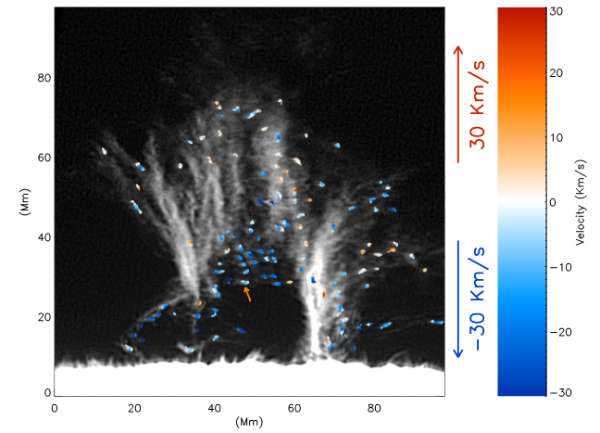
Solar coronal holes are regions where magnetic field lines extend into interplanetary space, serving as important source regions for the formation of the fast solar wind. With lower density and temperature than the surrounding corona, they appear as dark "holes" in extreme-ultraviolet wavelengths. Spicules, by contrast, are slender, transient brightening phenomena distributed throughout the solar chromosphere. They connect the solar surface to the corona and act as crucial channels for mass and energy supply.
The research team expanded their self-developed radiative and partially ionized modules to cover the region from the upper convection zone to the low corona. Under the open magnetic field configuration of coronal holes, they successfully conducted MHD simulations that captured the full physical process from self-excited convective turbulence to the spontaneous generation of spicules.
The simulation results indicated that convective and turbulent motions frequently trigger small-scale magnetic reconnection and shock structures in the lower atmosphere. The combined effect of these two mechanisms drives the quasiperiodic formation of spicule groups. Although only a small amount of plasma ultimately flows into the low corona during the rising phase of the spicules, the average mass flux injected into the low corona (approximately 10-9 kg m-2 s-1) is sufficient to compensate for the solar wind mass loss in coronal holes. These plasma flows continuously excite localized slow-mode waves and shocks in the low corona, carrying an average outward energy flux of about 10–100 W m-2, which is dissipated through thermal conduction and compression to heat the low corona.
The team noted that these slow-mode waves and slow-mode shocks are locally re-excited by the plasma flows entering the corona, rather than being generated in the lower atmosphere and propagating upward.
Furthermore, using high-resolution data from joint observations by the IRIS satellite at 2796 Å and SDO/AIA at 171 Å and 193 Å, the researchers identified quasiperiodic upward-propagating perturbations commonly present in coronal holes. These perturbations appeared as alternating bright and dark slanted ridges in time–distance maps, with measured propagation velocities of approximately 100–150 km/s. The onset of these perturbations typically coincided with the rising phase of spicules in the lower atmosphere.
By synthesizing extreme-ultraviolet images from simulation data and analyzing the evolutionary paths of spicules, the team found that these perturbations are jointly caused by the density increase from spicule upflows entering the corona and the temperature increase resulting from heating by slow-mode waves and slow-mode shocks. The mutual validation between numerical simulations and observational results demonstrates for the first time that slow-mode waves and shocks can be locally excited and efficiently dissipated in the low corona of coronal holes, establishing them as a non-negligible mechanism for coronal heating in open-field regions.
This study goes beyond the conventional view that slow-mode waves struggle to propagate into the corona. It shows that slow-mode waves excited and dissipated within the coronal hole environment also serve as an important mechanism for low coronal heating, thereby enriching the theoretical framework of coronal heating.
This work is supported by the CAS Strategic Priority Research Program, China's Space Origins Exploration Program, and other funding sources.
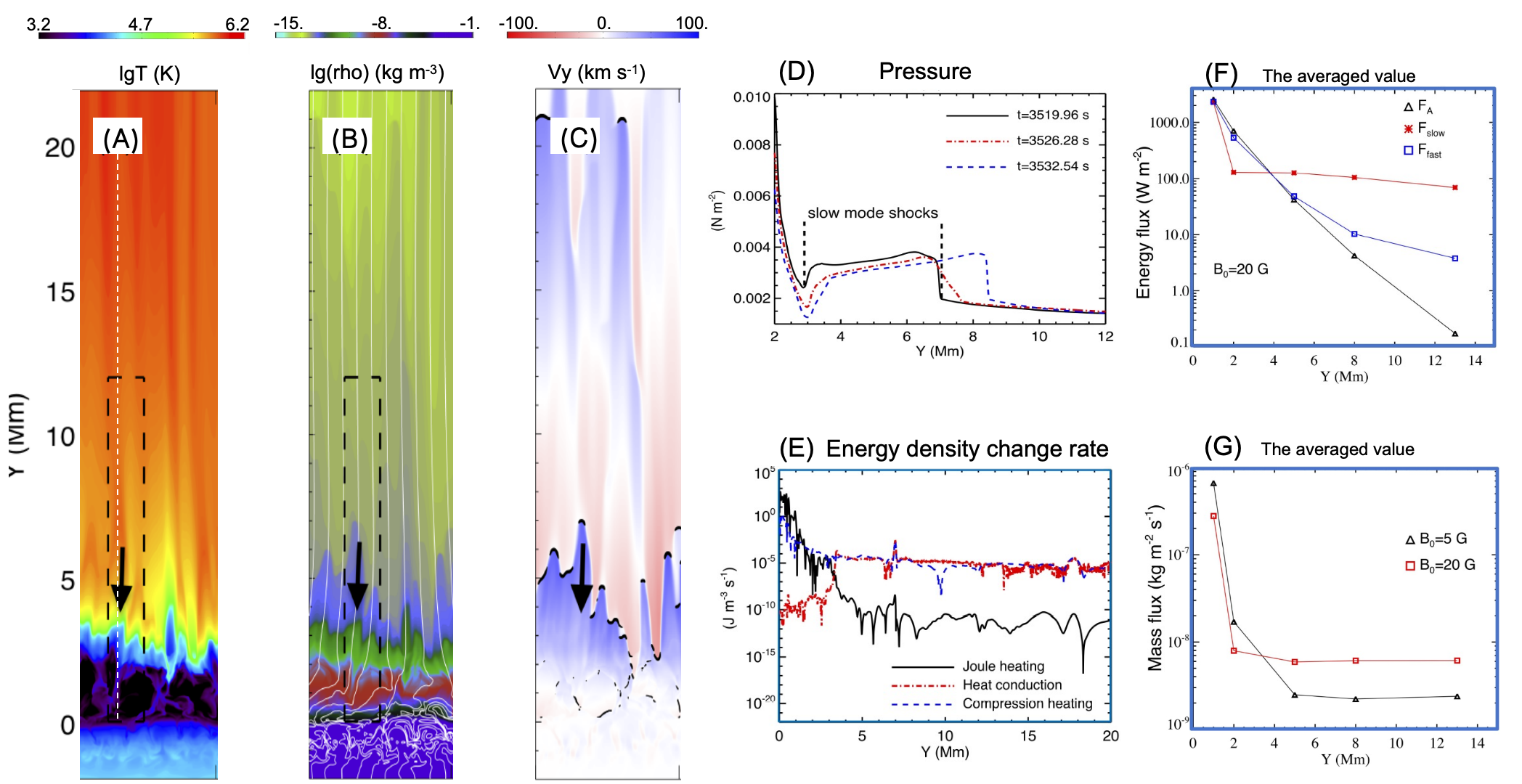
Numerical simulation results of solar spicules. (Image by NI Lei)