Newsroom


Feed costs account for approximately 70% of total aquaculture production costs. For genetic breeding scientists, developing new aquaculture varieties that combine rapid growth with high feed conversion efficiency (FCE) has long been a primary goal—one that can reduce farming costs, boost production efficiency, and minimize waste discharge from aquaculture systems.
However, the key regulatory genes underlying FCE in aquatic animals, as well as the molecular mechanisms linking rapid growth to high FCE, remain poorly understood.
To fill this knowledge gap, a research team led by Prof. MEI Jie from the Institute of Hydrobiology (IHB) of the Chinese Academy of Sciences has discovered that deficiency in miR-200a/200b enhances both growth and FCE in yellow catfish (Pelteobagrus fulvidraco) by upregulating stat5b expression.
The study was recently published in Science China Life Sciences.
The researchers first established a yellow catfish breeding population with both rapid growth and high FCE traits. A genome-wide association analysis mapped a key locus near the miR-200 cluster on chromosome 23, revealing that miR-200a and miR-200b were significantly downregulated in individuals with fast growth and high FCE.
Further experiments showed that CRISPR/Cas9‑mediated knockout of miR‑200a/200b in yellow catfish significantly enhanced growth and FCE, with no notable rise in average feed intake.
By integrating TargetScan prediction, miRNA-RNA pulldown, and sequencing analyses, the team identified several key target genes related to growth and metabolism, including stat5b and fasn. Among these, stat5b was confirmed as a core target of miR-200a/200b—and stat5b-transgenic yellow catfish also exhibited significantly improved growth and FCE.
These findings indicate that miR-200a/200b enhances nutrient utilization primarily by regulating energy metabolism-related target genes and signaling pathways. The study provides important theoretical support and technical guidance for unraveling the coupling mechanism of high-yield and feed-saving traits, as well as for the precise genetic improvement of these traits in aquaculture species.
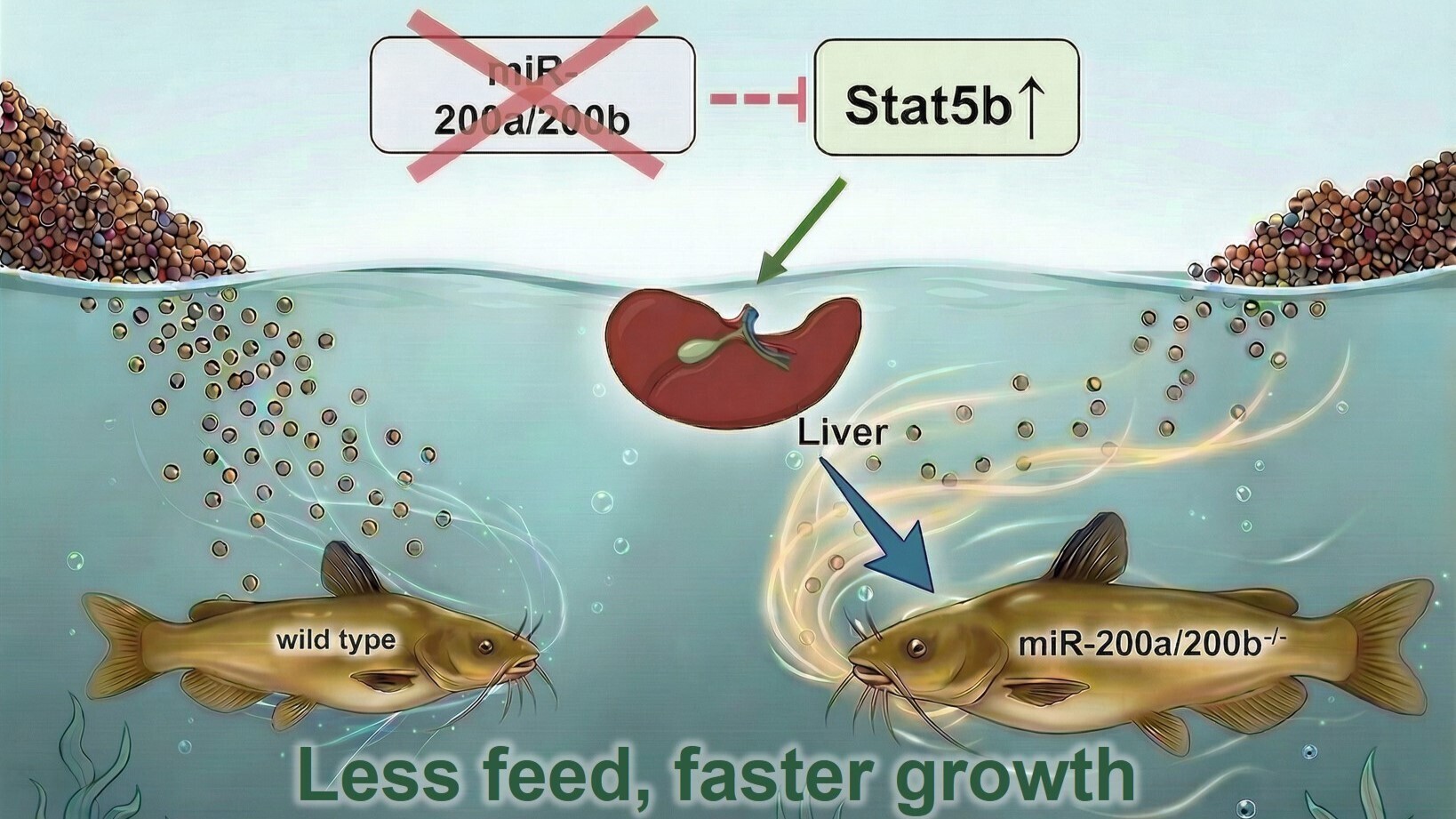
CRISPR-based editing improves catfish growth and nutrient use efficiency. (Image by IHB)