Newsroom


Soil microorganisms play a key role in regulating terrestrial biogeochemical feedbacks as global temperatures rise, controlling carbon and nitrogen cycling. Microbial carbon use efficiency (CUE) and nitrogen use efficiency (NUE) are core indicators that link microbial metabolism to the cycling of carbon and nitrogen in the soil. However, it is unclear whether the temperature sensitivities (Q10) of these two efficiencies are coordinated across broad geographic scales.
In a new study published in Global Change Biology, researchers led by Prof. WANG Chao from the Institute of Applied Ecology of the Chinese Academy of Sciences revealed a significant coupling between the temperature sensitivities of CUE and NUE, with higher Q10 values at lower temperatures and a shift in the primary drivers from biotic to abiotic factors as temperature increased.
To investigate this phenomenon, the researchers collected soil samples along a 4,000 km forest transect spanning eastern China. They quantified microbial CUE, NUE and their respective Q10 values using 18O and 15N isotope tracing techniques at 12 °C, 20 °C, and 28 °C.
The results showed that the temperature sensitivities of microbial carbon and nitrogen use efficiencies were closely related across temperature ranges. Notably, the researchers found that the Q10 values of CUE and NUE were higher in the lower temperature interval (12-20 °C) than in the warmer interval (20-28 °C).
Further analysis highlighted the mechanisms driving these sensitivities. The temperature sensitivities of CUE and NUE were positively associated with the temperature sensitivity of microbial growth. At lower temperatures, biotic factors such as microbial community properties governed the Q10 values of CUE and NUE. However, as temperature increased, abiotic factors such as precipitation patterns and the soil's nitrogen-to-phosphorus ratio, became the dominant regulators.
"Our study demonstrates that the environmental controls on microbial efficiency are not static," said Prof. WANG. "By identifying how these drivers change with temperature, we can provide more accurate data to refine Earth system models and better predict how forest ecosystems respond to a changing climate."
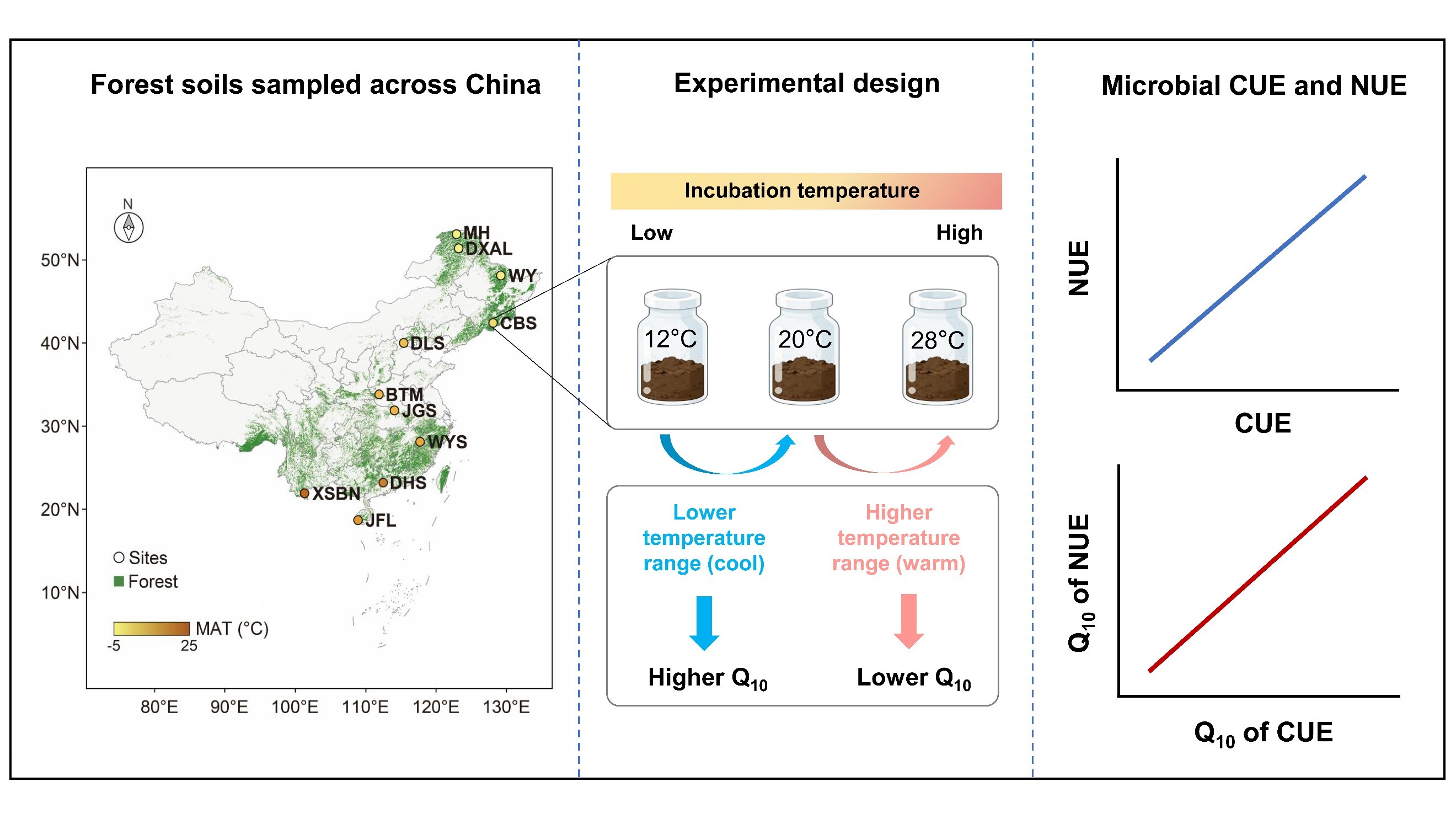
Study location, experimental design, and overview of the coupled temperature sensitivity of microbial carbon and nitrogen use efficiencies (Image by WANG Chao)