Newsroom


August Weismann’s germ plasm theory of the late 19th century posited that only germ cells, e.g., sperm and egg cells in animals or pollen and ovule cells in plants, transmit genetic information to the next generation, and that somatic mutations represent an evolutionary dead end. This theory has been highly validated in animals, whose germ cells are formed and segregated early in the organism’s development.
Since plants develop their reproductive organs relatively late, however, it has been widely believed that germline segregation also occurs late, i.e., during flower formation. This timeline would challenge the applicability of Weismann’s germ plasm theory to plants and suggest that somatic mutations in plants might be heritable.
To determine whether Weismann’s germ plasm theory is applicable to plants, researchers from Dr. QIAN Wenfeng’s lab at the Institute of Genetics and Developmental Biology (IGDB) of the Chinese Academy of Sciences tested the theory in Arabidopsis.
The study was published in Current Biology on March 30.
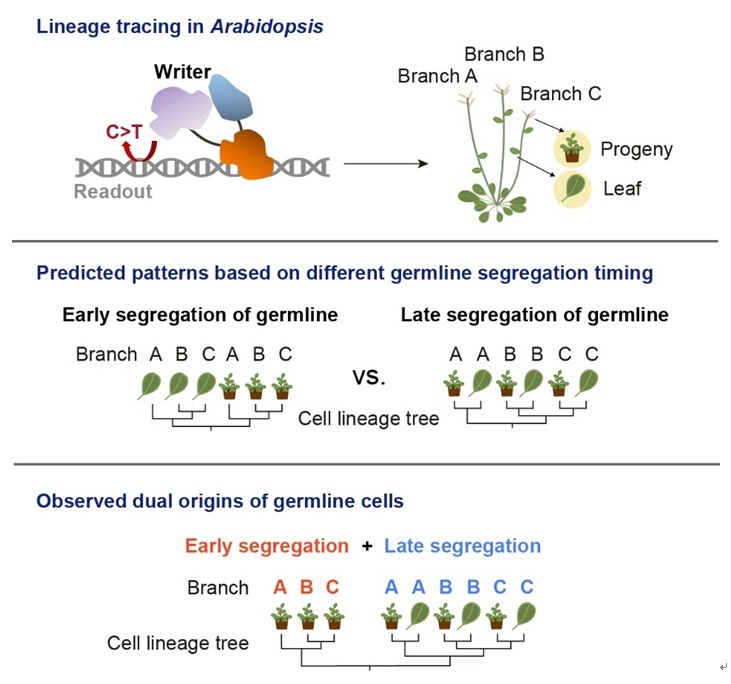
By using a dynamic editing-based lineage tracing system, researchers recorded cell developmental trajectories in Arabidopsis. They found that during cell division, the base editor AID (“writer”) continuously introduced heritable mutations into the synthetic DNA “readout” sequence, enabling the progressive accumulation of lineage information.
Through deep sequencing, researchers identified somatic mutations occurring in parental leaves as well as germline mutations transmitted to the progeny. They then employed these mutations to reconstruct the cell lineage tree connecting somatic cells and germline cells in Arabidopsis.
Based on the cell lineage tree, researchers discovered two distinct patterns of germline segregation in Arabidopsis: Some germline cells segregated during inflorescence meristem formation (late segregation), while others segregated earlier than branch formation (early segregation), providing support for a plant counterpart to Weismann’s germ plasm theory. By identifying this early segregation, the scientists determined that germline segregation in Arabidopsis occurred earlier than previously thought.
In summary, this work provides insight into how plants balance developmental plasticity with safeguarding genetic integrity in their progeny. It also highlights the role of meristem organization in limiting heritable mutations and deepens our understanding of plant development, environmental adaptation, and genomic evolution.