
Newsroom


Global production of polystyrene exceeds 20 million metric tons each year, representing roughly 6% of total plastic output. Yet less than 1% of polystyrene is recycled, largely due to its chemical inertness and stable carbon-carbon and carbon-hydrogen bonds. Conventional recycling technologies are highly energy-intensive, while elemental sulfur — an abundant byproduct of petroleum refining — remains underutilized in high-value applications.
To address this challenge, a research team from the Dalian Institute of Chemical Physics of the Chinese Academy of Sciences, working with researchers from Northeastern University, has developed a novel solar-driven co-upcycling strategy that enables the synergistic valorization of waste polystyrene and elemental sulfur. The approach integrates clean solar energy with the high-value utilization of industrial byproducts.
The findings were recently published in Journal of the American Chemical Society.
Taking advantage of elemental sulfur's dual function as both a photothermal agent and a reactant, concentrated sunlight rapidly heats mixtures of waste polystyrene and elemental sulfur to temperatures above 320 °C in under two minutes. Under these conditions, the eight-membered rings of elemental sulfur molecules open to form reactive sulfur radicals, which initiate polystyrene chain scission through hydrogen atom abstraction. The in-situ generation of degraded polystyrene and char further sustains a self-catalyzing photothermal cycle, boosting overall conversion efficiency.
This solvent-free and noble-metal-free process selectively converts waste polystyrene into high-value chemicals, including 2,4-diphenylthiophene (34% yield) and 1,3,5-triphenylbenzene (16% yield, valued at over $400 per kilogram).
Furthermore, the strategy is compatible with a broad range of post-consumer polystyrene wastes — including disposable tableware, packaging materials, and laboratory consumables — as well as substituted polystyrene derivatives, styrene-acrylonitrile copolymer, and acrylonitrile-butadiene-styrene copolymer, demonstrating its suitability for mixed plastic waste streams.
The study provides a promising new route for mitigating plastic pollution and improving the comprehensive utilization of sulfur resources.
"This work converts two low-value feedstocks into high-value products while using solar energy to reduce dependence on fossil resources," said Prof. CHEN Qingan, the study's corresponding author. "It represents a promising step toward sustainable plastic recycling and a circular economy."
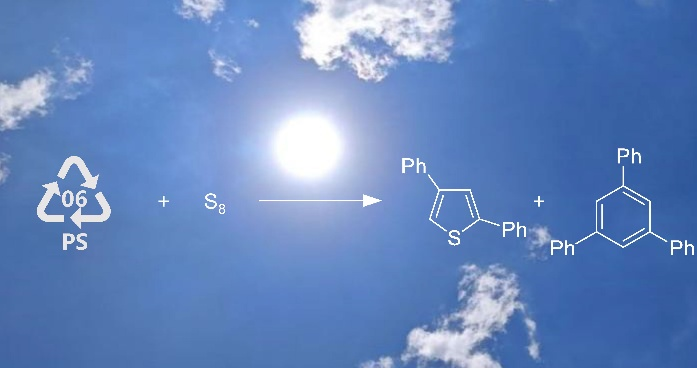
Solar-driven upcycling of polystyrene enabled by elemental sulfur. (Image by LIU Yong and LIU Heng)
