
Newsroom


A new study led by Prof. LI Zhi from the Xinjiang Institute of Ecology and Geography (XIEG) of the Chinese Academy of Sciences reveals that vegetation dynamics play a pivotal role in shaping global runoff changes—an effect that intensifies dramatically at certain aridity thresholds.
The study was recently published in One Earth.
Terrestrial runoff—the freshwater that flows across land surfaces into rivers, lakes, and oceans—is driven by the balance between precipitation and evapotranspiration. As global temperatures rise, many regions have seen increased precipitation. According to the study, global total runoff increased by 6.83 millimeters between 2000 and 2020. However, the researchers found that vegetation dynamics offset nearly 30% of this increase.
"As vegetation greens up, especially in response to warmer climates and longer growing seasons, it draws more water into the biosphere through evapotranspiration and root water uptake," Prof. LI said. "This reshapes the traditional relationship between precipitation and runoff."
In arid regions, such as grassland ecosystems, the study shows that the contribution of vegetation activity to runoff variability can reach as high as 47.57±15.99%.
Additionally, the researchers highlight a non-linear relationship between vegetation dynamics and runoff regulation. Using the Normalized Difference Vegetation Index (NDVI) as an indicator of vegetation dynamics, they found that when the aridity index (AI) drops below 0.57, the sensitivity of runoff to vegetation changes spikes sharply. In other words, in drier environments, small shifts in plant cover can trigger outsized impacts on water flow.
"Our research examines how vegetation changes under climate change physically alter the terrestrial water cycle," said Dr. LIU Yongchang, first author of the study. "By quantifying these mechanisms, we can provide data and theoretical support for effective ecological restoration and regional water security."
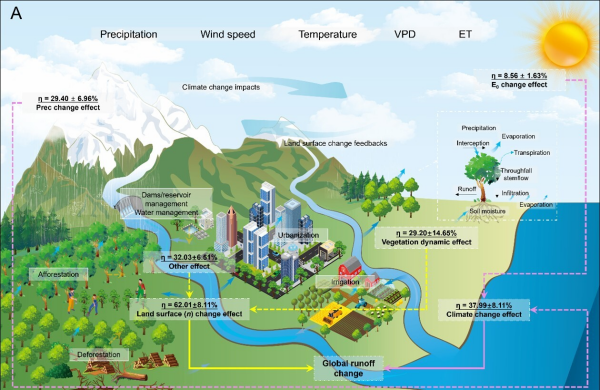
Schematic of the effects of climate change, vegetation dynamics, and other land-surface changes on global runoff variability. (Image by XIEG)
