
Newsroom


Chinese scientists have developed helium-3–free cooling technology that can reach 106 millikelvin, marking the lowest temperature achieved by a metal magnetocaloric material without using the scarce global resource helium-3. This breakthrough is expected to provide a self-sufficient, controllable "super refrigerator" that is critical for advancing frontier quantum technologies.
The study, conducted by researchers from the Hefei Institutes of Physical Science of the Chinese Academy of Sciences (CAS), the Institute of Theoretical Physics of CAS, and Shanghai Jiao Tong University, introduces a metal-based cooling strategy that eliminates the dependence of helium-3.
Their findings were published in Nature on February 11.
Ultralow-temperature environments (below 1 kelvin, or -272.15 °C) are essential for quantum computation, precision measurement, and quantum matter studies involving large-scale scientific facilities operating under extreme conditions. Currently, mainstream dilution refrigeration technology for sub-kelvin cooling relies heavily on helium-3. This dependence is as a key limiting factor for the development of quantum technologies and other fields requiring ultralow-temperature environments.
Helium-3-free solid-state cooling technologies, including adiabatic demagnetization refrigeration, have long faced a fundamental challenge. The core materials tend to exhibit poor thermal conductivity, much like a "wooden block" that remains cold internally but cannot rapidly dissipate heat. As a result, cooling power remains limited. An ideal magnetocaloric material must combine high cooling capacity with rapid heat transport, analogous to the properties of a metal—a key challenge that has remained unresolved until now.
To address this issue, the researchers designed and synthesized a novel three-dimensional alloy. Experiments revealed that the material enters a remarkable state known as a metallic spin supersolid, which combines two seemingly contradictory characteristics. It acts as a powerful "heat-absorbing sponge" that uses the magnetocaloric effect to cool down to 106 millikelvin (approximately -273.05 °C), the lowest temperature achieved by a metal magnetocaloric material without helium-3.
At the same time, the material exhibits thermal conductivity that is 50 to 100 times higher than that of conventional magnetocaloric materials. This combination enables the material to generate cooling and dissipate heat instantly.
This work marks a paradigm shift in spin supersolid research, moving it from basic research toward practical application.
By addressing both helium-3 dependency and the limited cooling power, this study is expected to provide substantial support for advancing quantum technologies and other cutting-edge fields that rely on ultralow-temperature environments.

Schematic Diagram of Metallic Spin Supersolid and Its Magnetic Refrigeration (Image by XU Xitong)
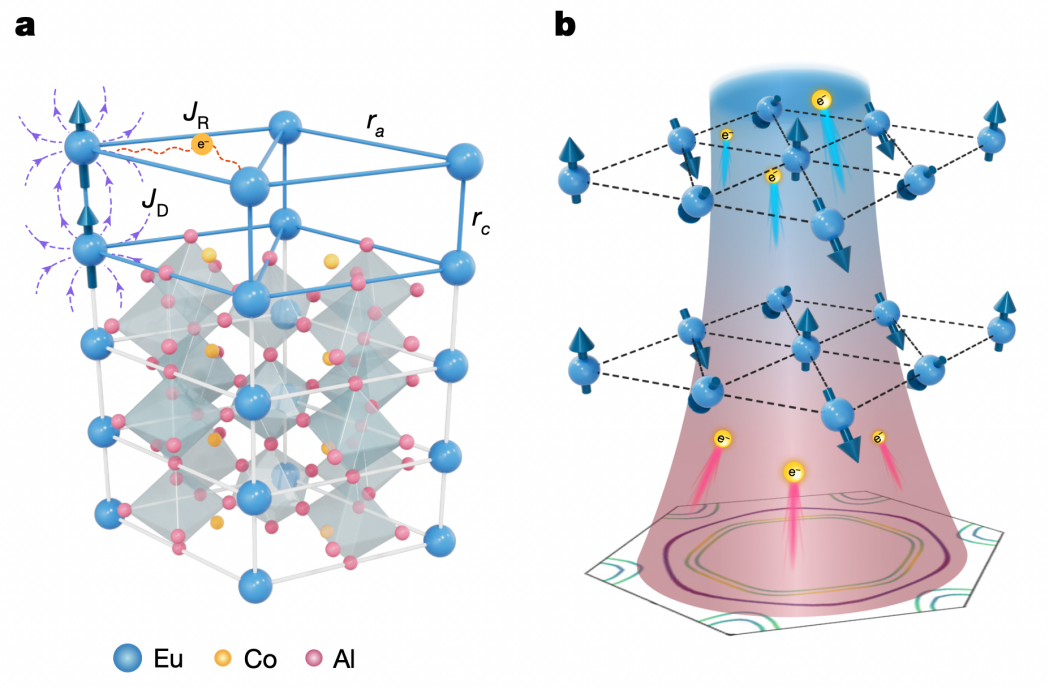
Lattice structure, key magnetic interactions of ECA, and the resulting spin supersolid state with large entropy change and efficient heat transfer. (Image by XU Xitong)


