
Newsroom


A research team from the National Time Service Center (NTSC) of the Chinese Academy of Sciences has investigated critical trade-offs in the design of broadcast ephemeris for low Earth orbit (LEO) navigation satellites, offering new guidance for the development of next-generation positioning, navigation, and timing (PNT) systems.
The findings, published in GPS Solutions on February 10, clarify how orbital height, fitting interval, and the number of ephemeris parameter jointly affect both ephemeris accuracy and parameter stability.
LEO satellites have demonstrated great potential to enhance the existing GNSSs for better Positioning, Navigation, and Timing (PNT) services. The availability of high-accuracy and reliable broadcast ephemeris for LEO satellites is a crucial prerequisite for such augmentation, as it determines whether accurate satellite orbital information can be effectively transmitted to ground users. Although extensive research on broadcast ephemeris modeling for GNSS satellites has been conducted since the last century, those established strategies cannot be directly applied to LEO navigation augmentation systems.
LEO satellites orbit much closer to the Earth, traveling at higher velocities and experiencing stronger perturbations from high-order gravity terms and atmospheric drag. For generating high-accuracy and reliable broadcast ephemeris for LEO satellites, proper ephemeris fitting is required. Meanwhile, the distribution of various ephemeris parameters is also of concern, as setting proper thresholds is important when designing the satellite navigation message, yet it is rarely studied.
To address these challenges, the researchers analyzed 12 LEO satellites flying at altitudes ranging from 300 to 1,400 kilometers with different orbital characteristics were selected for 16-, 18-, 20-, and 22-parameter ephemeris fitting. Three critical factors: the orbital height, the ephemeris fitting interval, and the number of ephemeris parameters, were considered in the investigation of the probability distributions of various ephemeris parameters and the ephemeris fitting accuracy.
The researchers found that increasing the orbital altitude and extending the fitting interval can both enhance concentration in the distributions of ephemeris parameters, whereas increasing the number of ephemeris parameters induces the opposite effect. Meanwhile, the distributions of several crucial ephemeris parameters exhibit certain correlations with the satellite orbital altitude and inclination, which requires special attention when designing LEO broadcast ephemeris.
Regarding the ephemeris fitting accuracy, increasing the orbital altitude and the number of ephemeris parameters can both improve the fitting accuracy, whereas extending the fitting interval degrades the fitting accuracy. Furthermore, LEO satellites operating above 1,000 km demonstrated greater flexibility in achieving high-accuracy ephemeris through adjusted fitting strategies.
According to Prof. WANG Kan, leader of the LEO-augmented PNT team at NTSC, the results provide practical guidance for ensuring sustained and reliable ephemeris design in future LEO navigation satellite systems.
The analysis in this study reveals an inherent trade-off in future architecture design of LEO satellite navigation messages: improving ephemeris fitting accuracy inevitably increases parameter dispersion. Pursuing minimal fitting errors without restraint may therefore require broader parameter thresholds, raising demands on data transmission resources and potentially affecting message reliability.
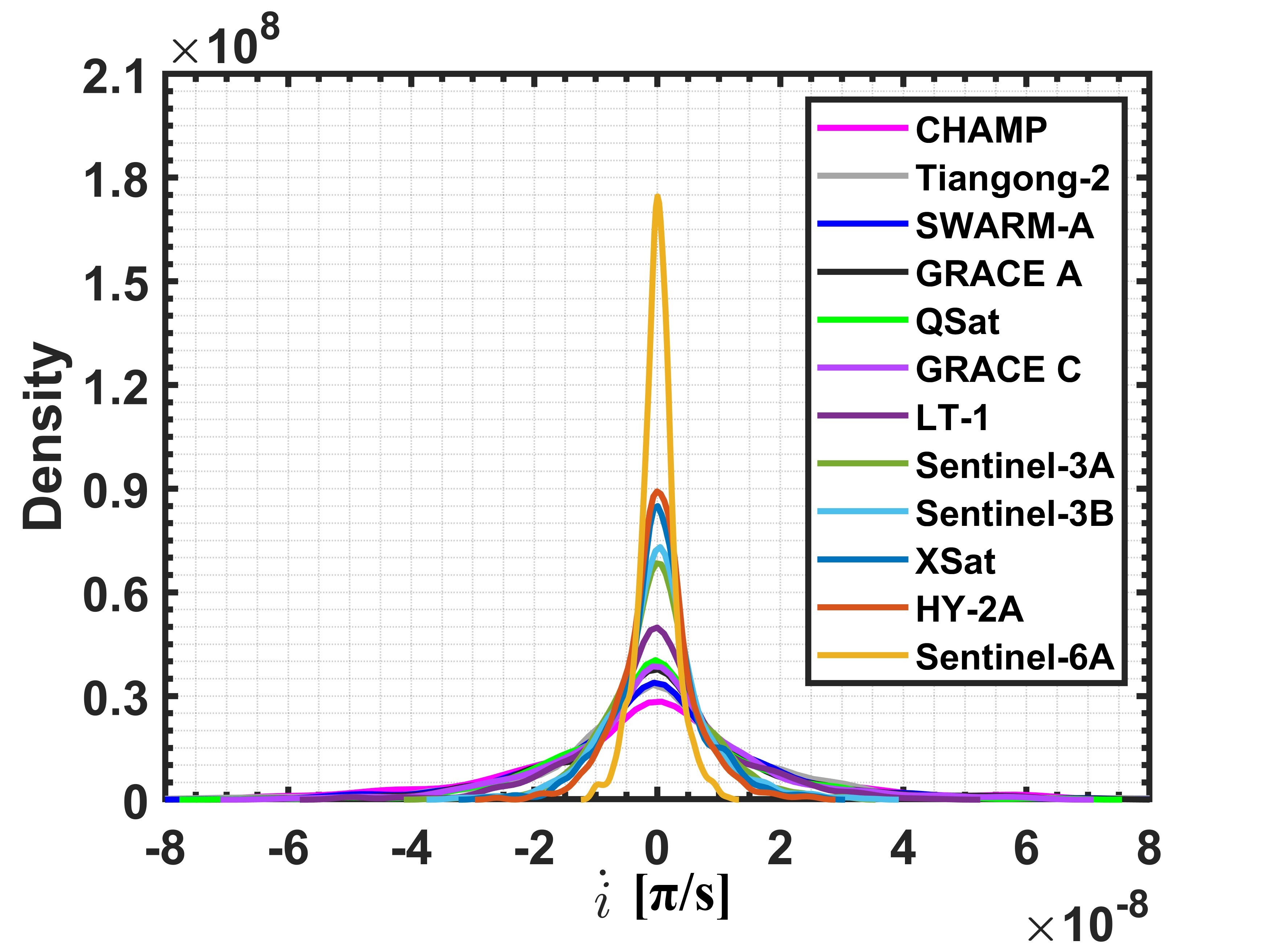
Probability density distribution of the orbital inclination rate using the 16-parameter model with a 10-min fitting interval for the 12 selected LEO satellites. The satellites are ranked from low to high altitudes in the legend (Image by WEI Chunbo& WANG Kan)
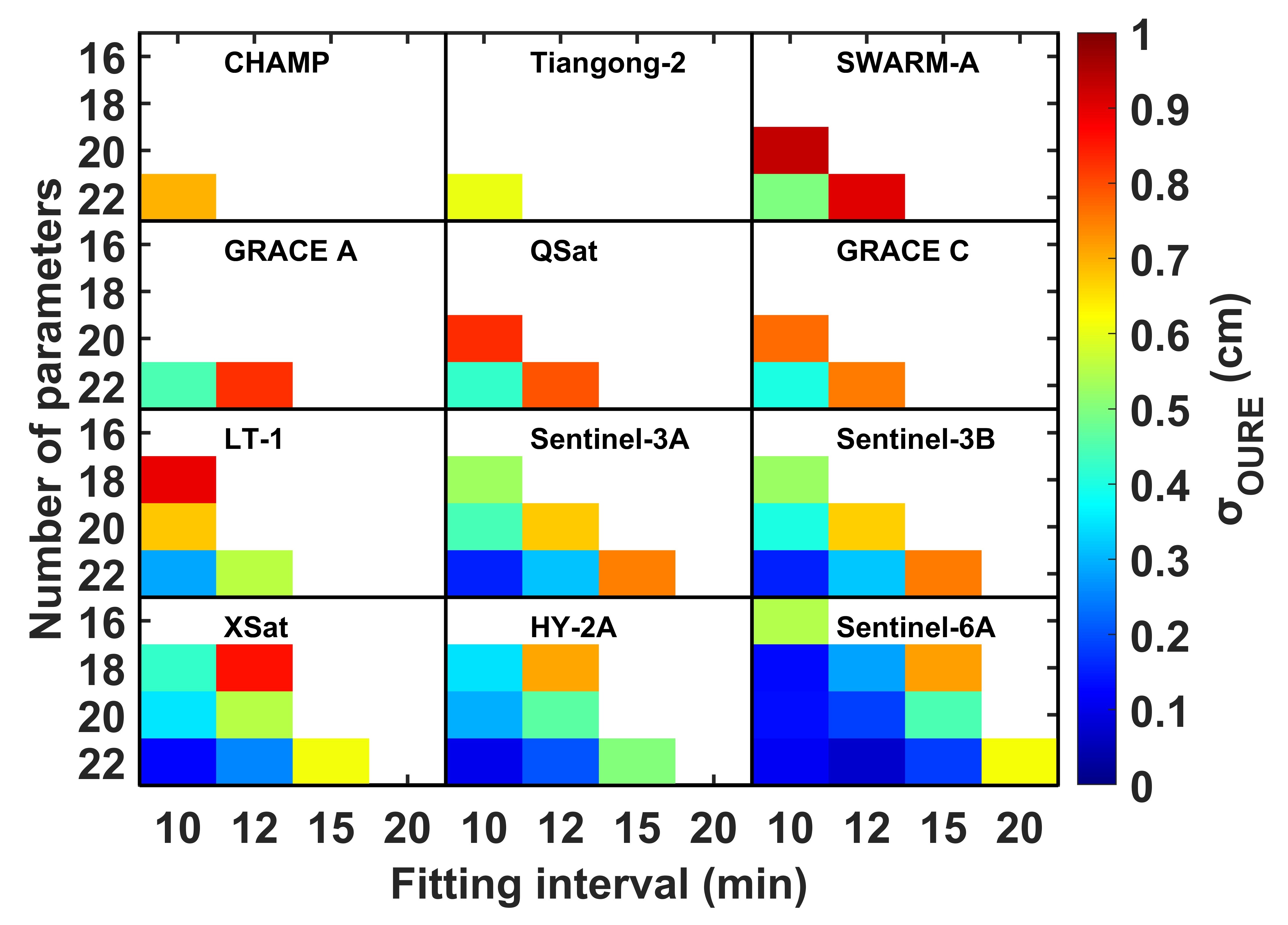
Available strategies for LEO satellite ephemeris fitting with a fitting accuracy below one cm (Image by WEI Chunbo & WANG Kan)
