
Newsroom


Pinpointing when early land plants colonized terrestrial environments and began influencing Earth's systems is a core question in the evolution of the Earth system. A research team led by Prof. ZHAO Mingyu at the Institute of Geology and Geophysics of the Chinese Academy of Sciences (CAS) has uncovered evidence indicating that land plants may have started reshaping Earth's surface environments far earlier than previously recognized.
Their findings were published in Nature Ecology & Evolution on February 24.
Land plants differ fundamentally from marine primary producers in that they generate organic matter with significantly higher organic carbon-to-phosphorus ratios. As land plants spread across the continents, terrestrial photosynthesis intensified, boosting organic matter production on land. This organic matter was subsequently transported to the oceans, elevating the organic carbon-to-total phosphorus (Corg/Ptotal) ratios preserved in marine sediments. Given the close link between terrestrial organic carbon production and marine carbon burial, Corg/Ptotal ratios in marine siliciclastic sediments serve as a valuable proxy for tracking terrestrial organic carbon input and terrestrial net primary productivity.
In this study, the team analyzed marine siliciclastic sediment records spanning a range of redox conditions. They detected a pronounced rise in Corg/Ptotal ratios starting approximately 455 million years ago.
An assessment of potential controlling factors shows the most plausible explanation for this shift is a sharp increase in terrestrial net primary productivity, driven by the early expansion of land plants. Mixing model results further reveal that since the Late Ordovician, terrestrial organic carbon has accounted for about 42 ± 15% of the total organic carbon buried in marine sediments—a figure comparable to modern values (30–57%). Palaeocontinental analysis suggests land plant expansion may have occurred earlier on the Laurentian continent.
Additionally, the study finds that fluctuations in Corg/Ptotal ratios exhibit two distinct increases that coincide with major carbon isotopic excursions during the Late Ordovician. This correlation implies that increased inputs of phosphorus-poor, carbon-rich terrestrial organic matter to marine sediments enhanced global organic carbon burial. Elevated organic carbon burial would have spurred atmospheric oxygen accumulation while lowering atmospheric carbon dioxide levels. These effects may have been amplified by intensified silicate and phosphorus weathering associated with the rapid colonization of land by plants.
Collectively, these processes demonstrate that the earliest emergence and expansion of land plants likely played a pivotal role in driving Earth's surface oxygenation and climatic change. Their spread may have contributed to the Late Ordovician glaciation and indirectly influenced the mass extinction events of this period.
This research was carried out in collaboration with scientists from Yale University, the University of Exeter, the University of Leeds, the University of Science and Technology of China, and the CAS Institute of Vertebrate Palaeontology and Palaeoanthropology.
This work was supported by the CAS Strategic Priority Research Program (Category A), the National Key Research and Development Program of China, and the National Natural Science Foundation of China.
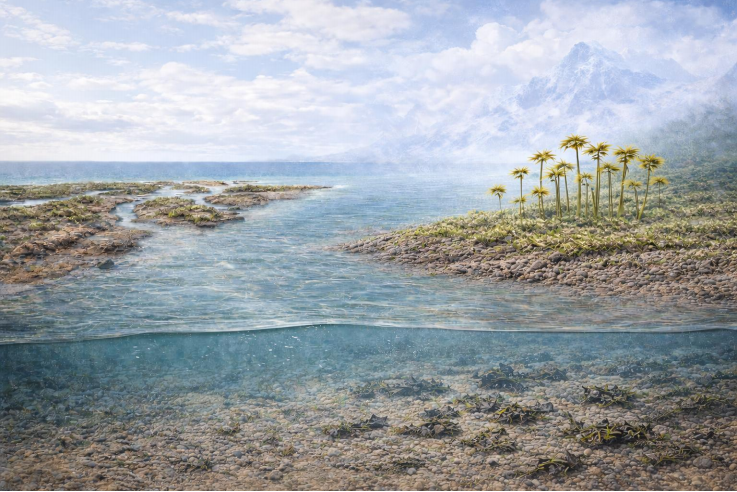
Early land plants reshaping Earth's surface environments in the Late Ordovician. (Image by CAI Jiachen)
