2024


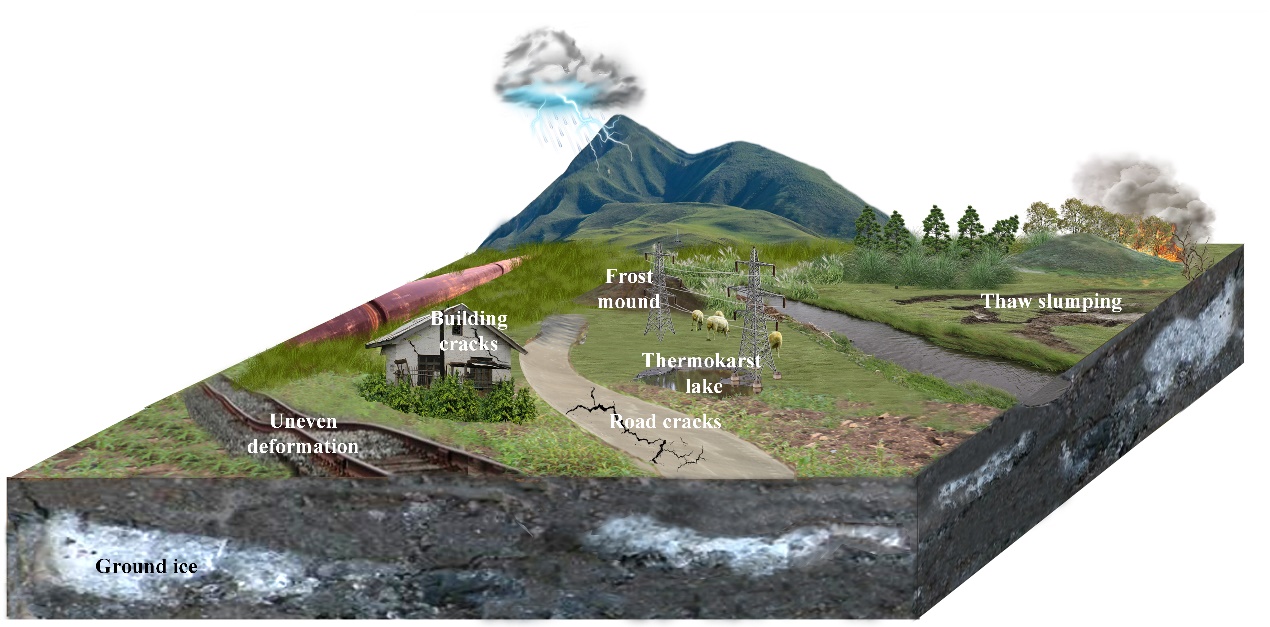
Recent global climate warming has significantly affected slope stability in permafrost regions, leading to an increased risk of landslides. While much of the current research focuses on specific types of landslides, such as thaw-induced slumps, there is a lack of comprehensive studies examining elevation-dependent landslide characteristics and their relationship to permafrost degradation.
A research team led by Prof. WU Tonghua at the Northwest Institute of Eco-Environment and Resources of the Chinese Academy of Sciences (CAS) conducted a systematic inventory and classification of landslides in the Babao River Basin of the Qilian Mountains from 2009 to 2018. This study utilized multi-source high-resolution remote sensing imagery and UAV surveys.
This work was published in Advances in Climate Change Research on Nov. 29.
The study identified three types of landslides: slides, flows, and slumps. From 2016 to 2018, the researchers recorded 105 landslide events, which accounted for 52% of the total, indicating a significant increase in landslide activity.
Notably, the average elevation of landslide occurrences rose from 3,343 meters to 3,474 meters—an increase of approximately 130 meters. This upward shift in landslide activity closely corresponds with the rising lower boundary of permafrost, as evidenced by comparisons with model-based permafrost distribution maps.
Landslide activity was mainly concentrated in discontinuous permafrost zones between 3,200 and 3,800 meters. The intensified freeze-thaw cycles in these areas reduced surface mechanical strength and increased pore water pressure, further exacerbating landslide risks.
Further analysis shows that climate change, driven by rising annual temperatures and increased precipitation, has significantly raised the lower permafrost boundary and reduced slope stability in discontinuous permafrost regions.
This study offers initial insights into the interactions between landslides and permafrost degradation, providing crucial evidence for predicting and preventing geological hazards in high-altitude regions. As climate warming continues, landslide activity in high-altitude permafrost areas is likely to increase, raising the frequency and intensity of such disasters.
To address these challenges, it is urgently necessary to enhance high-resolution landslide monitoring, deepen process-based mechanistic research, optimize early warning systems, and develop more precise disaster prevention strategies.