2024


Recent decades have seen rapid warming in the Arctic, known as Arctic amplification, which has impacted the Arctic's cryosphere and ecosystems and influenced global weather and climate through changes in atmospheric circulation.
Atmospheric rivers (ARs) are narrow, transient corridors of intense water vapor transport, responsible for about 90% of poleward moisture movement despite only making up about 10% of atmospheric activity.
A recent study by an international team of scientists from China, the USA, Chile, and Belgium shed light on the driving factors behind changes in ARs and their contributions to long-term water vapor variability, especially during summer when Artic moistening is most significant.
Results of this study were published in the recent issue of Nature Communications.
Atmospheric rivers occur predominantly in mid-latitudes and transport warm, moist air toward polar regions.
"In recent decades, ARs have been transporting more water vapor to the Arctic, a phenomenon previously linked to global warming and Arctic amplification," said Prof. DING Qinghua from University of California, Santa Barbara, the study's corresponding author.
However, the new study found that internal variability, rather than anthropogenic forcing, is the primary driver of this change.
Scientists discovered a strong spatiotemporal connection between ARs and variables such as specific humidity, circulation, and temperature across different time scales, suggesting that similar physical mechanisms regulate them.
Notably, long-term changes in Arctic summer moisture due to ARs cannot be entirely attributed to human-induced climate change, according to model responses. The study found that low-frequency large-scale atmospheric circulation in the Arctic significantly influences AR activity.
After isolating the moisture changes attributed to ARs, the study revealed that since 1979, ARs have contributed to over 36% of the increase in Arctic summer water vapor trends. In areas such as western Greenland, northern Europe and eastern Siberia, especially, AR activity has markedly mounted, contributing to more than 50% of the water vapor trends increase.
"While ARs are generally seen as stochastic extreme atmospheric phenomena driven by synoptic scale systems, they play a crucial role in modulating Arctic water vapor variability and shaping long-term changes in Arctic summer moisture," said the study's lead author, Dr. WANG Zhibiao from the Institute of Atmospheric Physics of the Chinese Academy of Sciences.
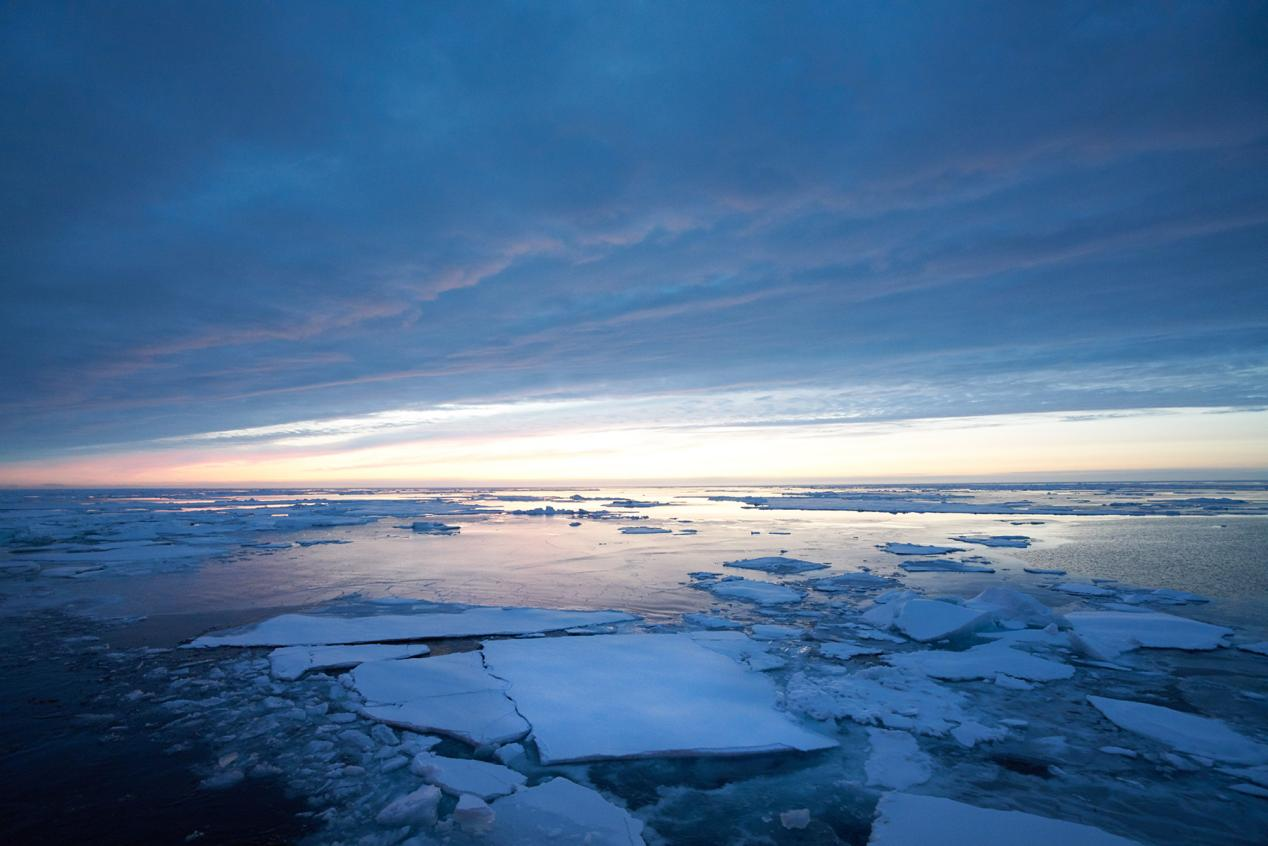
Melting ice in the Arctic Ocean. (Image by OUYANG Zhangxian)