
2023


Prof. DING Junfeng and his team from the Hefei Institutes of Physical Science (HFIPS) of the Chinese Academy of Science, together with Prof. ZHANG Genqiang from the University of Science and Technology of China, have achieved band gap optimization and photoelectric response enhancement of carbon nitride in the nitrogen vacancy graphite phase under high pressure.
Results were published in Physical Review Applied.
Graphitic carbon nitride (g-C3N4) has performed well in many fields, such as high-efficiency photocatalytic hydrogen production and water oxidation. However, the wide band gap of 2.7 eV of the original g-C3N4 limits its light absorption in the visible region. High pressure technology is an effective strategy to change the properties while remaining composition. Therefore, band gap engineering of g-C3N4 by high-pressure technology can significantly enhance its photocatalytic activity and improve its application potential.
In this study, the researchers prepared N-containing vacancy defect g-C3N4 nanosheets with a nitrogen/carbon ratio of 9:10 by alkali assisted thermal polymerization.
Later, a series of investigations were carried out on the band gap evolution and photoelectric response behavior of g-C3N4 under high pressure. They used a diamond anvil cell combined with Raman spectroscopy, synchrotron X-ray diffraction, high-pressure absorption spectroscopy, and photocurrent measurement techniques.
An important phenomenon was that g-C3N4 underwent a pressure-induced amorphization (PIA) from graphite to amorphous phase at 17 GPa. Under high pressure, the PL of N-deficient g-C3N4 changed from yellow to red, and the minimum band gap reached 1.70 eV.
The narrowed band gap enhanced light absorption in the visible region and increased the visible photocurrent from 18 nA to 29 nA. When the applied pressure was higher than the PIA transition pressure, a narrow band gap could still be maintained at ambient conditions, allowing a wide range of g-C3N4 band gap engineering from 1.87 eV to 2.42 eV.
This study provides a vacancy/defect assisted PIA strategy that could be used to design and tune the band gap of materials, and improve photoelectric performance for a variety of applications under ambient conditions.

Color change of g-C3N4 in diamond anvil cell under high pressure. (Image by CHENG Peng)
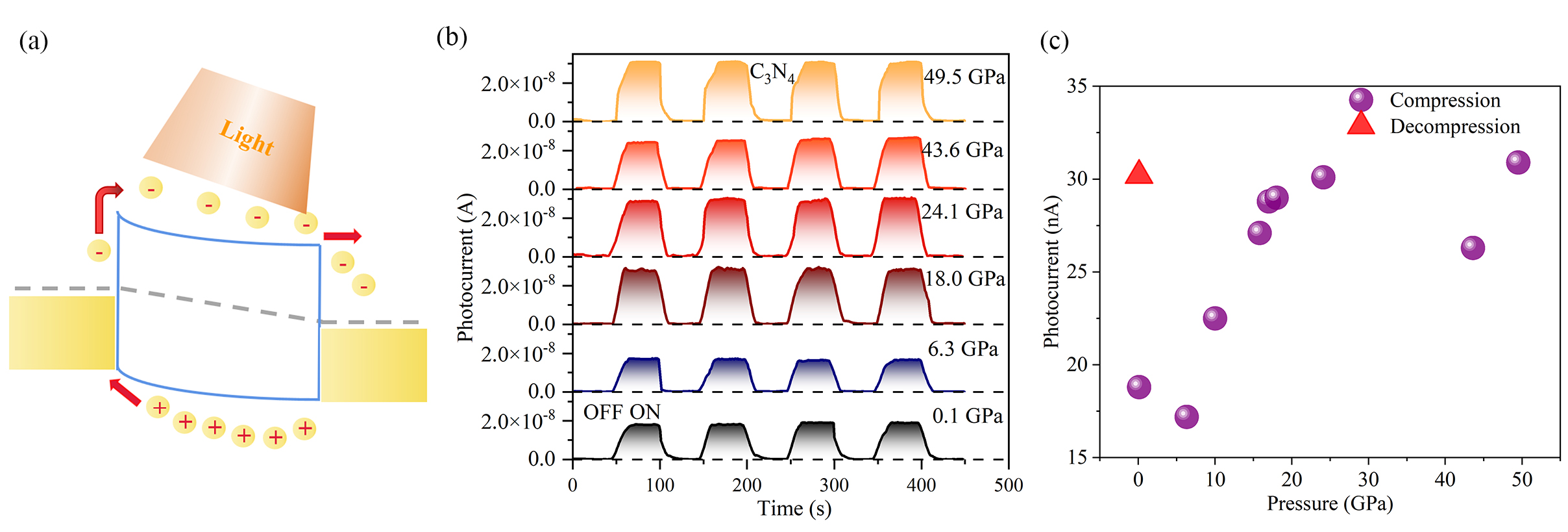
Visible-light responsiveness of C3N4. (Image by CHENG Peng)
