2023


According to a study recently published in Nature Communications, an international research team has observed the superconductor-insulator transition (SIT) and strongly tuned the anomalous Hall effect (AHE) in kagome metal CsV3Sb5 nanoflakes by proton gating.
"For the first time, we uncovered a disorder-driven bosonic SIT and sketched a global picture of the giant AHE as well as its correlation with the unconventional chiral charge density wave (CDW) in the AV3Sb5 family," said ZHENG Guolin from the Hefei Institutes of Physical Science (HFIPS) of the Chinese Academy of Sciences, first author of the study.
Topological kagome metals AV3Sb5 (A=K, Rb and Cs) exhibit rich physical properties due to the electronic correlations and topologically non-trivial band structures, including unconventional superconductivity, CDW, and giant AHE. The unique coexistence of electronic correlations and band topology in AV3Sb5 allows the study of possible quantum phase transitions among these correlated electronic states through disorders, magnetic fields and electric fields. Furthermore, the physical origin of the giant AHE and its correlation with CDW remains unresolved.
In this study, the researchers systematically investigated the low-temperature transport properties of CsV3Sb5 nanoflakes of different thicknesses under a protonic gate. They found that proton intercalation-induced disorder can rapidly suppress superconductivity in ultrathin CsV3Sb5 nanosheets (within 25 nm), and the resistance-temperature (R-T) curve shows semiconductor behavior at low temperatures.
At the higher gate voltage (>20 V), the sheet resistance of CsV3Sb5 nanoflakes at low temperature reached up to 106 Ω, several orders larger than the quantum resistance value of the Cooper pair (~6,450 Ω), indicating the SIT under strong disorder. However, unlike conventional insulators, the sheet resistance in the insulating state exhibits a saturation tendency for T →0 K, probably due to the incoherent tunneling between localized Cooper pairs.
For thicker CsV3Sb5 nanosheets (> 40 nm), the researchers found that a lower gate voltage (<7 V) does not change the superconducting transition temperature, i.e., the disorder effects are greatly reduced. However, the slope of the low-temperature Hall resistance changes continuously, suggesting a large tuning of the carrier densities.
Further analysis revealed that the giant AHE occurred mainly at the point M in the Brillouin zone with hole carrier density 2×1022 cm-3. Combined with theoretical analysis and first-principles calculations, the giant AHE in the system was mainly attributed to the skew scattering of holes in the flat band near the M point.
The work was financially supported by the National Key R&D Program of China and the National Natural Science Foundation of China.
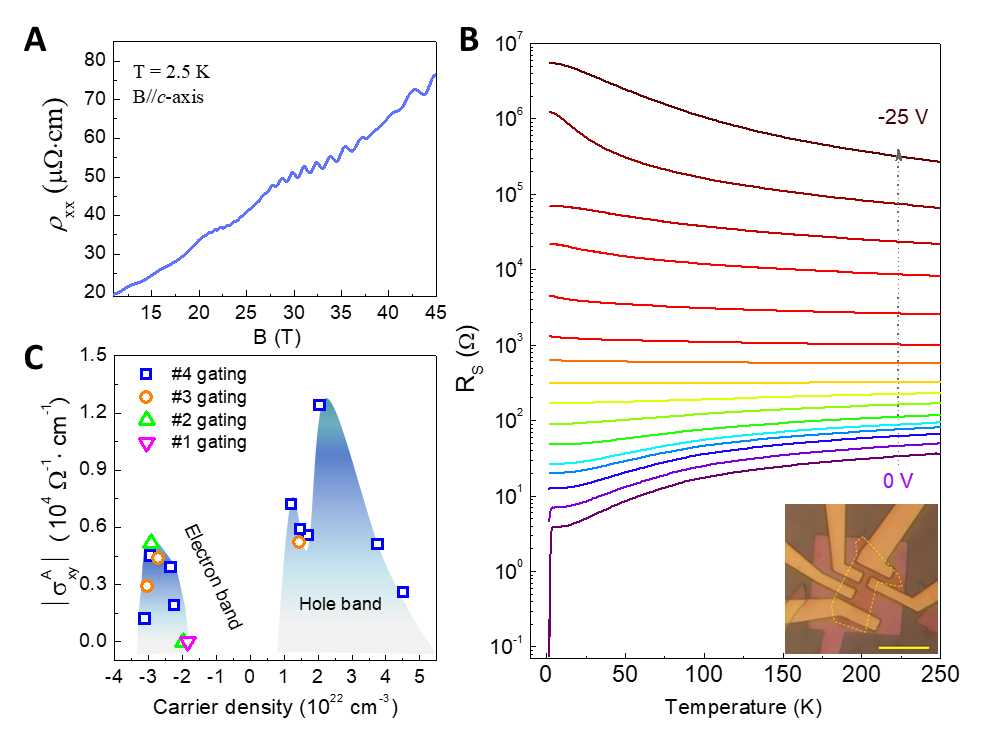
A. The quantum oscillation of CsV3Sb5 single crystal under high magnetic fields; B. The superconductor-insulator transition in untrathin CsV3Sb5 nanosheets induced by proton intercalation; C. The anomalous Hall conductivities under different carrier densities. (Image by ZHENG Guolin)