2022


Prof. ZHANG Yongsheng's research group at the Hefei Institutes of Physical Science of the Chinese Academy of Sciences has systematically investigated the thermoelectric (TE) properties of three pyrite-type IIB-VIA2 dichalcogenides (ZnS2, CdS2, and CdSe2), and explored the physical mechanisms and several chemical trends.
Their findings were published in Physics Review B.
Through high-throughput computations, the three pyrite-type IIB-VIA2 dichalcogenides (ZnS2, CdS2, and CdSe2) with simple cubic structure and cheap elements had been predicted to possess promising TE properties by the team. However, the detailed TE behaviors and the fundamental underlying physical mechanisms behind them still remain ambiguous.
In this study, the researchers investigated the thermal and electrical transport properties of the three pyrite-type IIB-VIA2 dichalcogenides, and evaluated their thermoelectric performances taking advantage of more accurate methods.
After calculating and analyzing the phonon properties, they concluded that all three pyrite-type dichalcogenides had localized high-frequency optical phonons contributed by their strongly covalently bound nonmetallic dimers and soft phonon modes contributed by their rattling like metal atoms, which resulted in their strong anharmonicities and low thermal conductivities.
There are also chemical trends where heavier atomic masses, larger atomic displacement parameters and longer bond lengths between metallic and nonmetallic atoms may lead to softer phonon frequencies.
Furthermore, all the three compounds showed promising electrical transport properties for both p-type and n-type doping due to their large density-of-states effective masses and small conductivity effective masses, which could be explained by the complex non-spherical iso energy Fermi surfaces in the valence and conduction bands.
Aside from that, they found the low lattice thermal conductivity and promising electrical transport properties contributed to their excellent thermoelectric performances.
"This study illustrates the effects of the localized nonmetallic dimers and the rattling-like metal atoms on the thermal transport properties, and the importance of different carrier effective masses to electrical transport properties in these pyrite-type dichalcogenides, which could be used to predict and optimize the TE properties of other TE compounds in the future," said JIA Tiantian, first author of the study.
The research was supported by the National Natural Science Foundation of China, the China Postdoctoral Science Foundation and the China Scholarship Council.
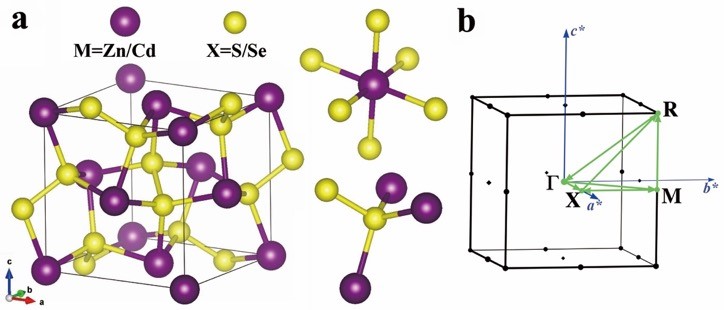
Figure 1. a. Crystal structures and bonds between atoms in the pyrite-type IIB-VIA2 dichalcogenides; b. The corresponding first Brillouin zone and its high-symmetry points. (Image by JIA Tiantian)
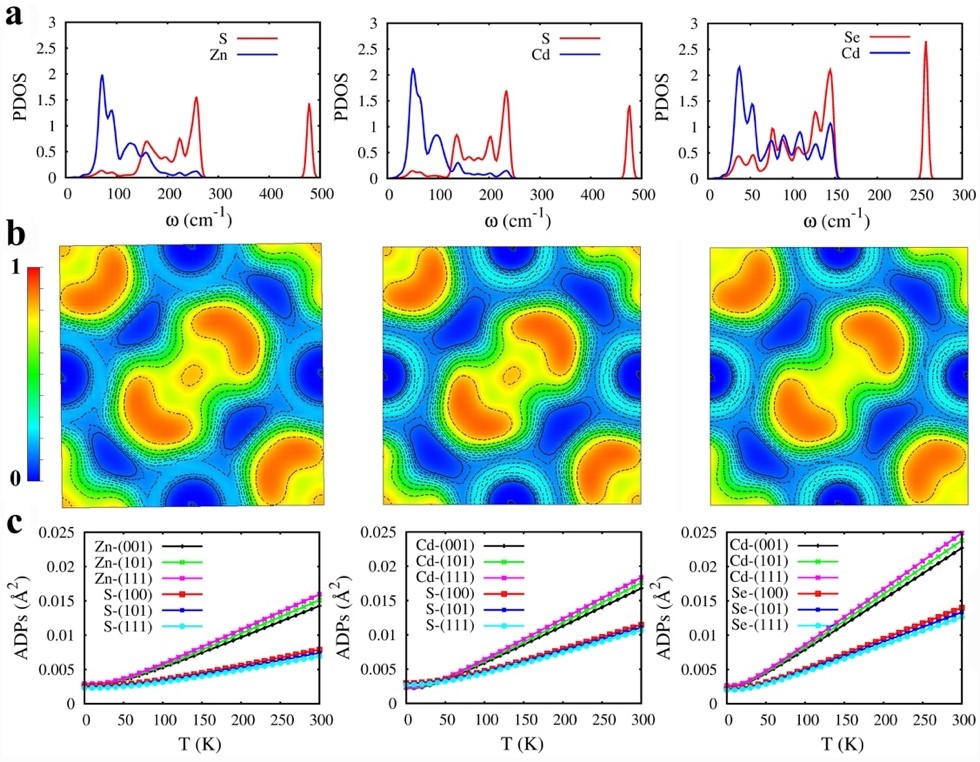
Figure 2. Calculated partial phonon densities of states. (Image by JIA Tiantian)
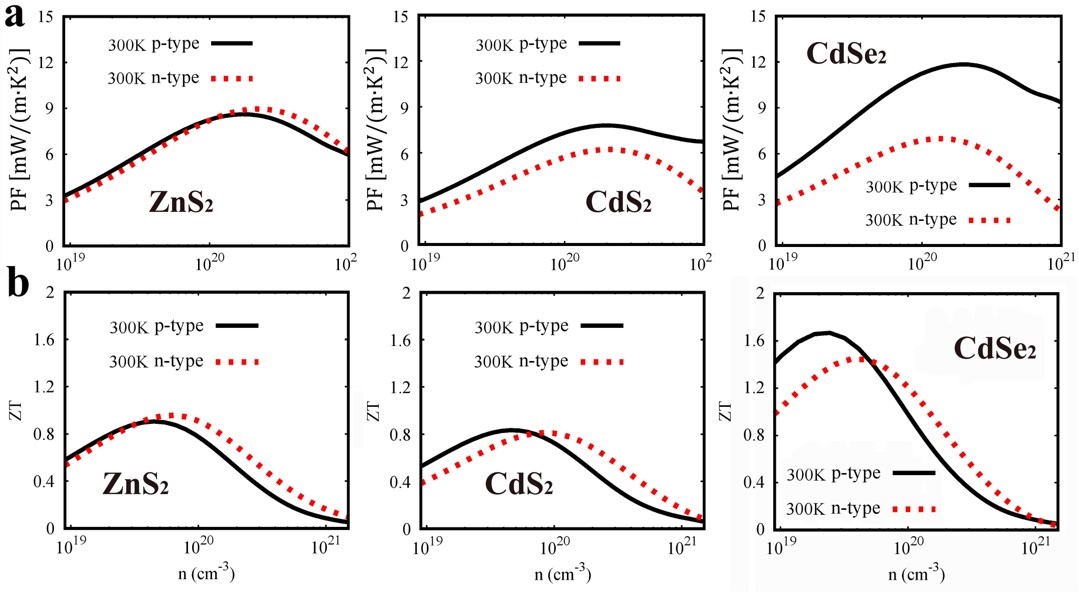
Figure 3. Calculated power factors (a) and figures of merit (b) as functions of the carrier concentration for p-type and n-type doping at 300 K in ZnS2, CdS2 and CdSe2 (from left to right), respectively. (Image by JIA Tiantian)