Headlines
Chinese Researchers Achieve Device-Independent Quantum Key Distribution over 100 km
|
Print


A team of researchers led by PAN Jianwei, ZHANG Qiang, and BAO Xiaohui from the University of Science and Technology of China (USTC) of the Chinese Academy of Sciences (CAS), along with other colleagues, has, for the first time, provided a critical building block for scalable quantum repeaters, enabling the team to subsequently achieve device-independent quantum key distribution (DI-QKD) over 100 km.
Their findings, which were published in Nature on January 2 and in Science on January 5, lay the foundation for the development of the quantum internet and strengthen China’s leading role in quantum technology.
Building efficient and secure quantum networks is the central goal of quantum information science. Quantum networks, integrating quantum precision metrology, quantum communication, and distributed quantum computing, provide high-resolution sensing of information, secure and efficient information transfer, and an exponential increase in information processing speed.
Deterministic entanglement distribution over long distances is a key prerequisite for scalable quantum networks, but the exponential loss of photons in optical fibers severely limits the distance of quantum entanglement distribution.
This limitation has also constrained quantum key distribution, which is central to quantum communication security. Although DI-QKD enables the quantum key to remain secure even if the device is potentially untrusted, the transmission distance under this scheme had previously been limited to a few hundred meters.
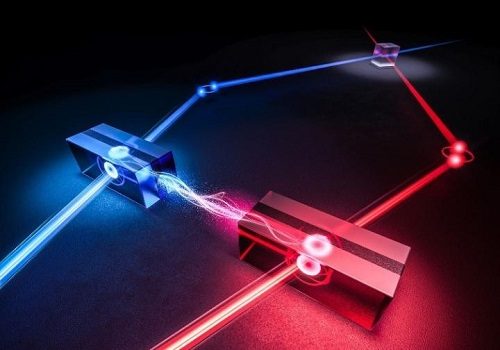
To overcome distance limits, the researchers built a quantum repeater system that demonstrated memory–memory entanglement between two nodes connected via entanglement swapping—thus achieving long-distance entanglement distribution.
This was the first time in the world that long-lived quantum entanglement suitable for scalable quantum repeater architectures was achieved. By maintaining entanglement significantly longer than the time required to establish inter-segment connections, this achievement paves the way for practical long-distance quantum networks.
Based on these achievements in quantum repeater technology, the researchers extended the distance of DI-QKD beyond 100 km for the first time—marking a critical leap toward scalable quantum repeaters by simultaneously realizing long-distance, high-fidelity atom–atom entanglement.
PAN Jiawei, a leader of the research team and a CAS member and executive vice president of USTC, noted the importance of quantum repeaters by calling them the “building blocks” enabling the linkage of universal quantum computers to be developed over the next 10–15 years.
“Therefore, the quantum internet will be realized, connecting precise information sensing and supercomputing, securely and efficiently,” said PAN.
Contact
Reference
Topics