Headlines
Chinese Scientists Develop Distributed Intercity Quantum Sensor Network to Expand Dark Matter Research
|
Print


Ordinary visible matter accounts for only about 4.9 percent of the universe, while dark matter makes up about 26.8 percent. Axions are hypothetical, extremely light particles—with field-like properties—that may help us understand dark matter. Researchers speculate that axion fields formed topological defects during phase transitions in the early universe. In turn, these defects are expected to interact with nuclear spins and induce signals as the Earth crosses them. Detecting these signals could thus be key to understanding dark matter; however, such signals are extremely weak and of short duration.
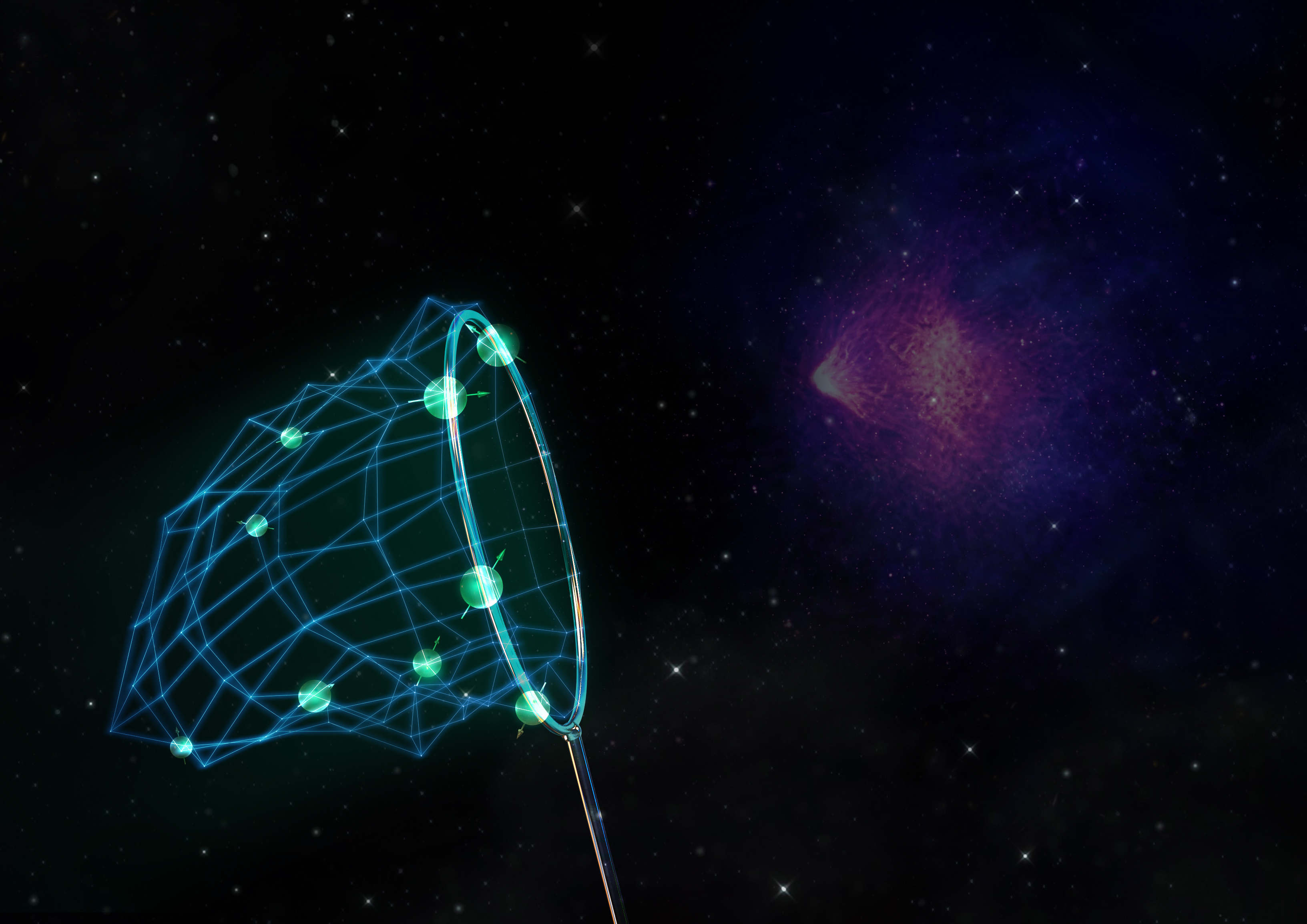
In order to identify such signals, researchers from the University of Science and Technology of China (USTC) of the Chinese Academy of Sciences and their collaborators developed the first intercity nuclear-spin-based quantum sensor network, thereby experimentally exceeding astrophysical observation constraints on dark matter associated with axion topological defects. The study was published in Nature on January 28.
In this experiment, the researchers developed a nuclear-spin quantum precision measurement that “stores” microsecond-scale axion-induced signals in a long-lived nuclear-spin coherent state, enabling a readout signal on the scale of minutes. Based on a self-developed quantum spin amplification technique, they enhanced the weak dark-matter signal by at least 100-fold and increased the sensitivity of spin rotation to about 1 μrad, about four orders of magnitude higher than previous techniques.
Furthermore, the researchers created the first intercity nuclear-spin based quantum sensor network to discriminate dark matter signals. This network consisted of five nuclear-spin quantum sensors geographically distributed across Hefei and Hangzhou with a baseline distance of approximately 320 km, which were synchronized using Global Positioning System (GPS) time.
Although no statistically significant topological-defect-crossing event was recorded during two months of observation, the researchers set the most stringent constraints on axion–nucleon coupling across an axion mass range from 10 peV to 0.2 μeV, achieving 4.1 × 10¹⁰ GeV at 84 peV.
This study provides the first laboratory experiment to exceed astrophysical constraints on axion topological-defect dark matter, opening up the possibility of examining unexplored parameter space. It provides a new way to probe topological-defect dark matter as well as a new direction for searches on broad beyond-Standard Model physics such as axion stars and axion strings.
Contact
Topics