Carbon Peaking & Carbon Neutrality: CAS in Action


Coastal wetlands serve as critical global "blue carbon" reservoirs, with allochthonous pre-aged carbon transported via land–ocean fluxes contributing more than 50% of the total carbon pool. Yet the mechanisms governing the storage of this pre-aged carbon within coastal ecosystems remain poorly understood. In particular, the interactions between mineral association and microbial processing represent a major knowledge gap in blue carbon science.
To address this gap, a research team led by the Yantai Institute of Coastal Zone Research of the Chinese Academy of Sciences, in collaboration with scientists from Tianjin University, the CAS Institute of Soil Science, and other institutions, conducted a systematic investigation of 36 mangrove and saltmarsh wetlands spanning a 20-degree latitudinal gradient along China's coastline.
Through comprehensive analyses of topsoils and 1-meter sediment cores, combined with radiocarbon (14C) dating, biomarker characterization, and model simulation, the team uncovered the synergistic regulatory mechanisms by which minerals and microbes jointly control blue carbon turnover and storage. The findings were recently published in Global Change Biology.
The study identified substantial differences in carbon turnover times between saltmarshes and mangroves. Saltmarshes, which feature high mineral accretion rates, displayed significantly longer soil organic carbon (SOC) turnover times than mangroves—approximately 2,200 years versus 500 years on average in topsoils. This divergence was mainly driven by the larger fractions of pre-aged carbon (around 50%) and petrogenic (fossil) carbon (around 20%) in saltmarshes. In terms of carbon partitioning, mineral-associated organic carbon (MAOC) accounted for 81.5% of SOC in saltmarsh topsoils, considerably higher than the 66.6% observed in mangroves. Saltmarshes also contained greater proportions of lignin phenols (3.5% versus 3.1%) and microbial necromass carbon (21% versus 14%). These results indicate that, in ecosystems dominated by allochthonous inputs, SOC is primarily supplied by a highly degraded, pre-aged carbon pool.
Furthermore, using linear mixed-effects models (LMM) and structural equation modeling (SEM), the researchers detected a significant depth-dependent shift in mineral–microbial interactions. In topsoils (0–20 cm), where fresh organic matter inputs are abundant, the accumulation of microbial necromass carbon was the dominant control on carbon turnover (coefficient = 0.36). By contrast, in deep soils (1 m), lignin degradation intensity surpassed microbial biomass as the primary predictor of multi-millennial organic carbon persistence (coefficient = 0.45).
This study proposes a new blue carbon sequestration mechanism underpinned by coupled mineral–microbial regulation: microbes transform and decompose allochthonous organic matter into relatively stable compounds, which are then physically protected by reactive minerals. These results challenge the conventional view that blue carbon storage is driven mainly by the direct burial of recent plant biomass. Instead, they highlight the essential role of coupled mineral–microbial processes in sequestering pre-aged allochthonous carbon, underscoring the need to integrate this mechanism into future blue carbon accounting and ecological management frameworks.
This work was supported by the National Natural Science Foundation of China, the National Key Research and Development Program of China, and the Natural Science Foundation of Shandong Province.
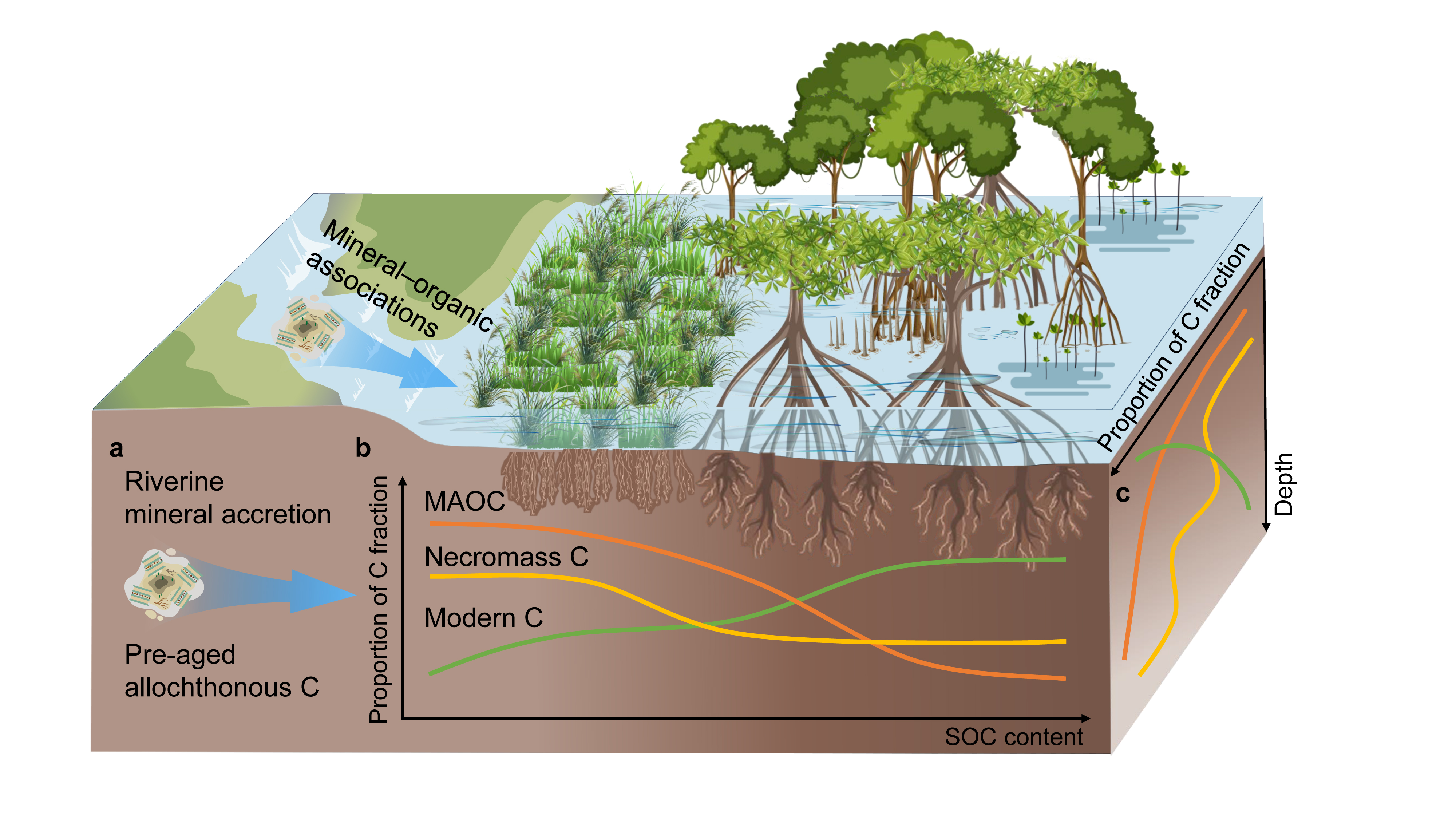
Conceptual model of mineral-microbial synergy driving the composition and turnover of coastal blue carbon. (Image by LI Yuan)